Is Distance Reiki Traditional?
7 August 2026
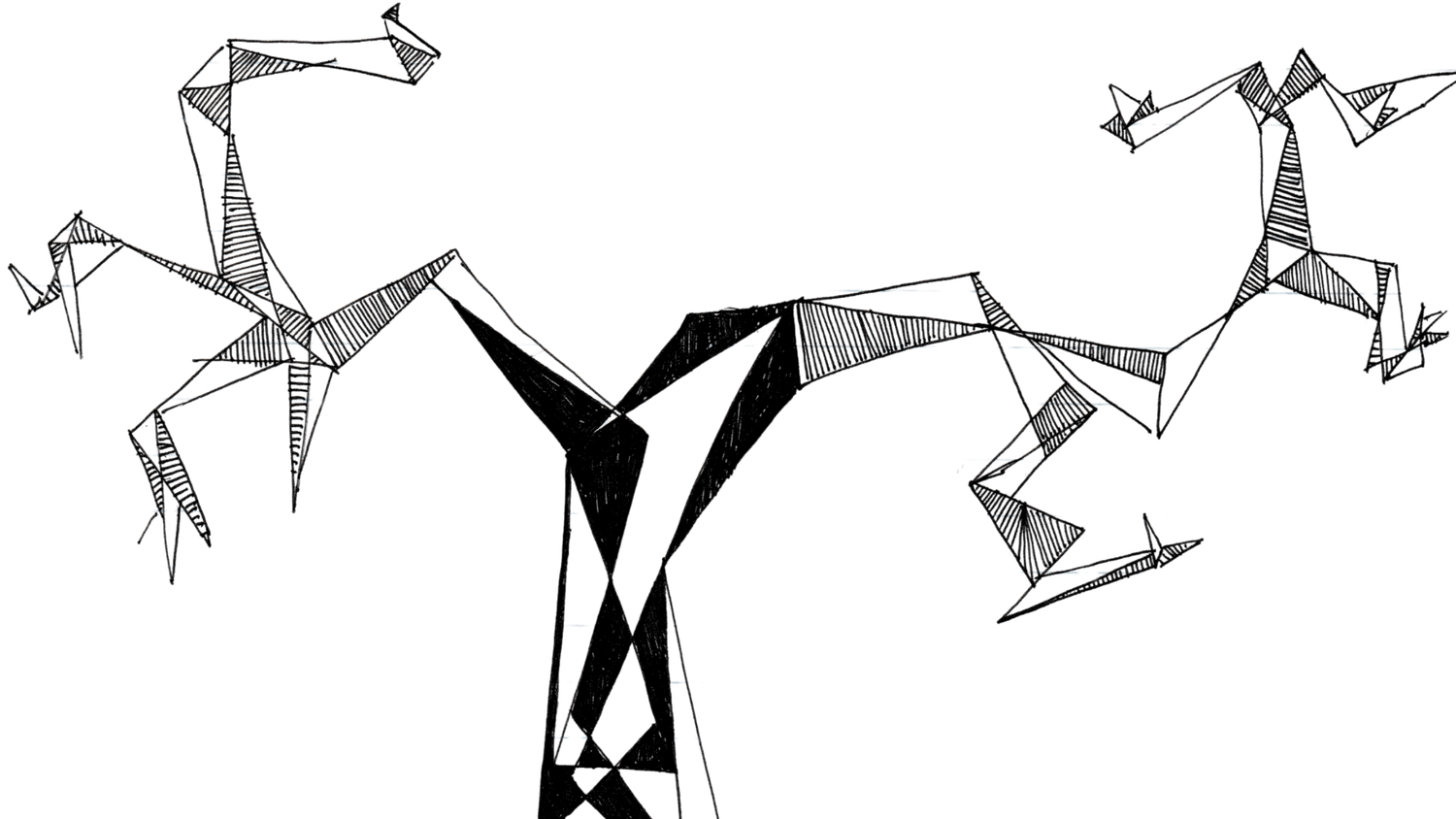
Unity, pen and ink. Part of the Schematics collection.
Short answer: yes. Distance work is taught at Okuden, the second level of the Usui system. It has a Japanese name, Enkaku Chiryo, and it is part of the standard curriculum. It is not a modern add-on and it was not invented to make Reiki sell online.
I want to be careful about how I answer this, though. A lot of what gets said about Reiki history is repeated confidently and sourced to nobody in particular. I am not going to add to that. What follows is what the lineages actually teach and what I have found in my own practice. Where I do not know something, I will say so.
Where it sits in the training
Reiki is usually taught across three levels. Shoden, the first, is largely about self-practice. You learn to work on yourself, and for many people that is where it stays.
Okuden, the second level, is where distance work is taught, along with the symbols associated with it.
That order is not arbitrary. Self-practice on its own is a genuinely good thing and it is where I started. But if you want to be of any use to another person, at some point you have to be able to offer it to someone who is not you. Distance work is one of the ways that becomes possible.
I sought this out deliberately. Self-healing had given me something real, and I wanted to be able to offer it to other people rather than only to myself.
The clearest answer to the question
If distance Reiki were a Western addition, you would expect it to be missing from the Japanese lineages that deliberately excluded Western influence.
It is not.
Jikiden Reiki traces from Usui to Chujiro Hayashi to Chiyoko Yamaguchi, who learned it in the 1930s and practised it unchanged for over sixty years. The whole premise of Jikiden is that it preserves the teaching as it was passed down, with nothing added and nothing removed, specifically bypassing the Western transmission that came through Hawayo Takata.
Enkaku Chiryo is taught in their Okuden curriculum.
That is about as clean an answer as this question gets. The lineage most committed to being un-Westernised teaches distance work at the same level I was taught it, and describes it as being for situations where treating someone in person is not possible.
There is also a related technique with its own name, Shashin Chiryo, photographic treatment, which uses a photograph of the person as the focus. Distance work in the tradition is not one vague idea. It is a set of named methods with a defined place in the training.
What I was taught
I was taught that distance work is part of the Usui system and that it is regarded as an advanced technique rather than a beginner's one. The symbols are part of it and were explained to me as a kind of training wheels rather than as the thing itself.
That is what my teachers passed on, in a line I can trace, and I am telling you it as teaching rather than as documented history. Those are two different kinds of claim and I would rather keep them separate than blur them to sound more certain.
The logic underneath it
This matters more than the history, because it is what makes the practice coherent rather than convenient.
Reiki rests on a premise of oneness. The way I understand distance work is close to the idea of the Buddha in me recognising the Buddha in you. Nothing is being flung across a gap. There is no signal travelling from my house to yours.
A note on that, because I do not want to be misread. I am not religious and Reiki is not a religion. It carries no dogma and asks you to believe nothing. It emerged in Japan, in a culture where Shinto and Buddhist ideas are part of ordinary life, so the language available to describe it came from there. That is cultural context rather than doctrine. I use the phrase because it is the clearest way I have found to say the thing, not because this is a spiritual practice you have to sign up to.
If the premise is that we are not fundamentally separate, then distance is not an obstacle to be overcome. It is simply not the relevant category. I am not bridging anything. I am recognising something that was already the case.
That is why the tradition does not treat distance as a lesser version of the work. Within its own logic, there is nothing to compensate for.
Whether you accept that premise is up to you. I am telling you what the practice rests on, not asking you to believe it.
So why do people assume it is a modern convenience?
I think there are two reasons, and one of them is fair.
The first is that distance work is emphasised more heavily in Western Reiki than in Japanese practice. If your exposure to Reiki is mostly online, distance work will look like the main event, when in the tradition it is one named technique among several taught at a particular stage.
The second is that some of what gets sold as distance Reiki has genuinely drifted. Reiki channelled into an object, an image described as carrying charge, a product that holds Reiki for you. I do not do any of that and I do not think it holds up. A recording of a session is a record of the session, not a store of anything.
When people are sceptical of distance Reiki, quite often what they are actually sceptical of is that. I do not blame them.
Where the line sits
Not between hands-on and distance. Between offering someone your attention for a real period of time, and selling them an object or a promise.
The first is Reiki whether or not you are in the room. The second is not Reiki at all.
Something I will say plainly: this work is not done while I am asleep or half attending to something else. The window I hold is a window I am actually in. That is where the value sits, and it is the same value in either format.
Does selling it online cheapen it?
It probably lowers how it is perceived, and I understand why. There are a lot of requests for free distance Reiki online, and no room hire, no table and no travel means there is less visible apparatus to attach a price to.
But the substantial thing being offered is the same in both cases. A practitioner who can genuinely get out of the way and hold attention for a sustained period is doing something, whether or not there is a building involved.
The value is just harder to place when there is nothing to look at. I think that is a pricing problem rather than a practice problem.
Is distance as good as hands-on?
Honestly, I do not think I have practised enough to answer that properly, and I would rather say so.
What I can say is that both serve the same purpose. Giving someone your undivided attention and intention for their highest good, for a defined period of time. On that measure they are the same act.
I have offered both, and I have had people report meaningful experiences from both. That is the extent of what my own experience supports.
What hands-on gives that distance may not
At my current level, byosen reading is more pronounced in a hands-on session.
Byosen is the traditional practice of noticing sensation in the hands during a session, and it is taught hands-on because it is a palpation skill. I feel hibiki, the sensation associated with it, in every hands-on session and in most distance ones. Most, not all. That difference is worth stating rather than smoothing over.
There is also something a physical space gives that a name on paper does not. A room creates a ritual. Someone lies down, the phone goes away, and there is a container that helps them stop doing things for a while. That is genuinely useful.
It cuts both ways, though. A ritual also creates expectation, and expectation shapes what a person notices. So I would not say the room is straightforwardly better. It is different, and it suits some people and not others.
My own teachers work mainly hands-on. Distance is practised but less commonly. I mention that because it is honest context for how I was trained.
What I am still unsure about
The mechanism. I have a background in exercise science and I went looking for one. I did not find a repeatable, solid answer, and I am not going to invent one. Reiki does not have a clean cause and effect relationship with any condition, so there is nothing specific I could honestly claim even if I wanted to.
Whether byosen reads reliably at distance. More practice is required before I can answer that, and I am currently in further training partly for that reason. I would rather tell you it is an open question than give you a confident answer I have not earned.
When I was first certified, I tested this as widely as I could. Friends and family. People who knew a session was happening and people who did not. With a recording, without one, live on camera. Photographs, and names written on paper. I was curious and I wanted to see what held up.
I am still doing that. It is the honest position for a practitioner who is still learning, which is what I am.
If you want to see what a session actually involves, I have written that out in detail. And if you would rather just try one, the free session is fifteen minutes and there is no cost.
Reiki is not a substitute for medical or psychological care.
Damian Carli
BilanciaAetheralis